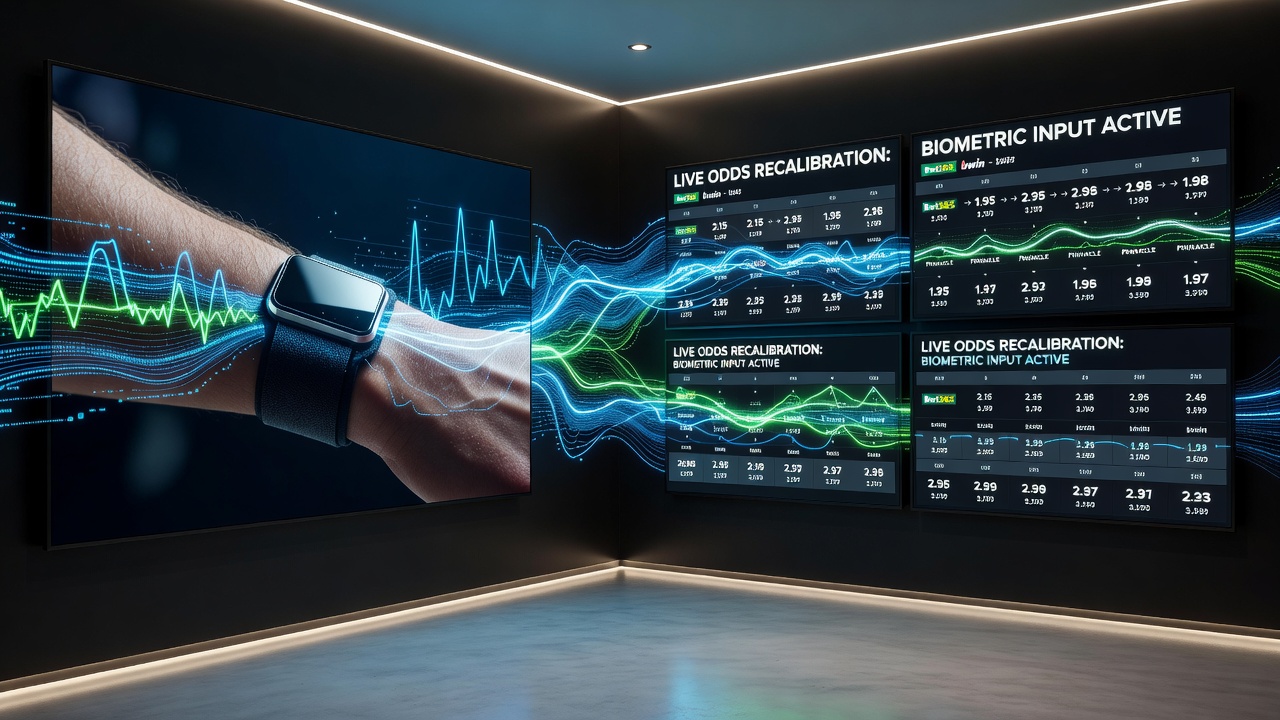
Biometric Sensor Data from Athlete Wearables Quietly Recalibrating In-Play Football Odds Across Major European Platforms
Football clubs across Europe outfit players with sensor-equipped wearables that capture heart rate variability, acceleration metrics, and fatigue indicators in real time, and these streams reach data aggregators who supply model updates to betting operators. Major platforms operating in Spain, Germany, and Italy integrate the feeds into algorithms that shift in-play odds on goals, corners, and player-specific markets within seconds of each update. Data indicates the adjustments occur most frequently during the middle third of matches when cumulative load metrics begin to diverge from pre-game baselines.
Data Collection Through Wearable Devices
Devices from manufacturers such as Catapult and STATSports attach to vests or armbands and transmit location, speed, and physiological signals via low-latency networks. Clubs grant selective access to aggregated outputs under commercial agreements that preserve raw files while allowing derived performance probabilities to flow outward. Observers note that heart-rate recovery intervals after high-intensity bursts correlate with reduced sprint frequency in subsequent phases, and platforms translate these patterns into probability decrements for attacking events.
Integration With Betting Platforms
Operators maintain direct feeds from multiple clubs through licensed data vendors, and the incoming packets trigger recalibrations in live betting engines. A player showing elevated lactate thresholds may see his team’s next-goal odds lengthen by several points while the opposition shortens correspondingly. Research indicates such micro-adjustments compound across thousands of concurrent markets, producing measurable divergence from odds derived solely from historical match data. Platforms in the German Bundesliga and Italian Serie A have documented higher frequency of these updates during evening fixtures when sensor coverage reaches near-complete squad penetration.

Regulatory and Privacy Framework
European data-protection rules require explicit consent for biometric processing, and operators must anonymize individual identifiers before odds models ingest the information. The European Commission’s guidelines on sports data innovation outline minimum standards for consent granularity and retention periods that several platforms adopted by early 2026. As of August 2026, German regulator GGL has begun spot audits of data flows between clubs and wagering entities to verify compliance with aggregation thresholds. European Commission guidance emphasizes that derived probabilities must not permit re-identification of any athlete.
Impact on Specific Markets
In-play corners and cards markets exhibit the largest shifts because fatigue metrics directly influence set-piece frequency and disciplinary actions. A midfielder whose workload exceeds seasonal averages by fifteen percent may trigger a ten-point swing in booking odds within a single window. Data from the 2025-2026 season shows that platforms using biometric layers recorded tighter closing spreads compared with those relying on video-derived statistics alone. Australian Institute of Sport analyses of similar sensor deployments in other codes confirm parallel patterns, suggesting the effect generalizes across high-intensity team sports. Australian Institute of Sport reports document comparable latency reductions when physiological signals supplement positional tracking.
Technical Infrastructure Requirements
Low-latency 5G slices and edge-computing nodes enable sub-second delivery of processed metrics to odds servers located in Frankfurt and Madrid data centers. Vendors apply Kalman filtering to smooth noisy sensor readings before the values enter probability engines, and operators maintain separate risk-management layers that cap exposure on any single biometric-driven adjustment. Those who have examined the pipelines note that fallback models revert to traditional statistics whenever packet loss exceeds predefined thresholds, preserving market continuity during brief outages.
Conclusion
Biometric sensor integration continues to expand across European football leagues, and the resulting data streams produce continuous, incremental recalibrations to in-play odds on major platforms. Regulatory oversight through bodies such as the GGL and adherence to European Commission standards shape how this information moves from club devices to betting engines. The technical architecture supporting these flows relies on established sensor hardware, anonymization protocols, and low-latency networks that together maintain market responsiveness while meeting privacy constraints.